
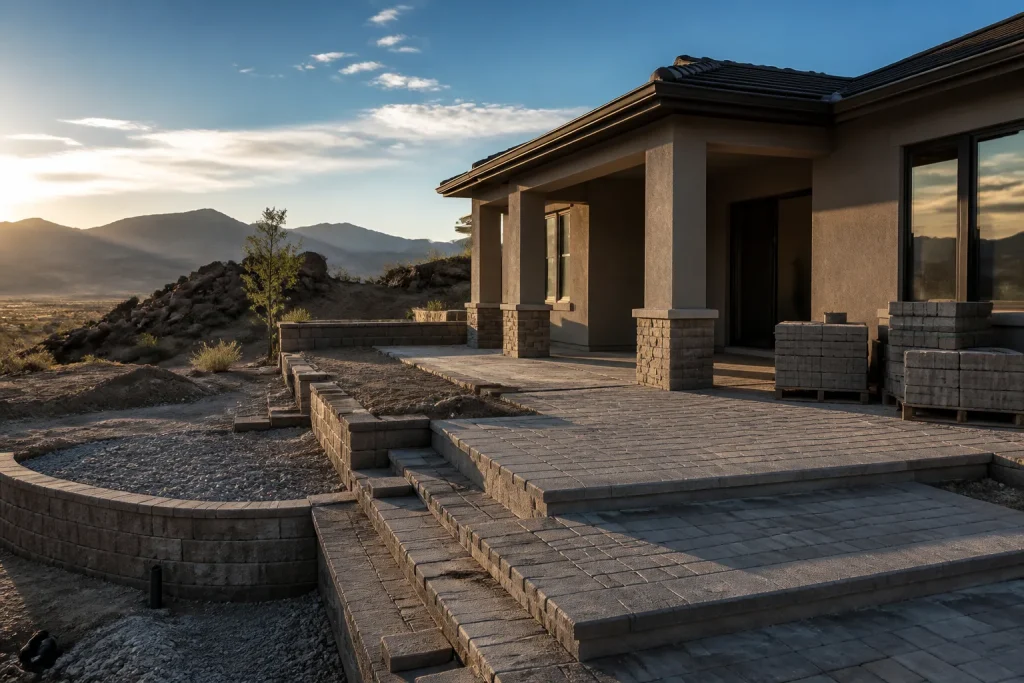
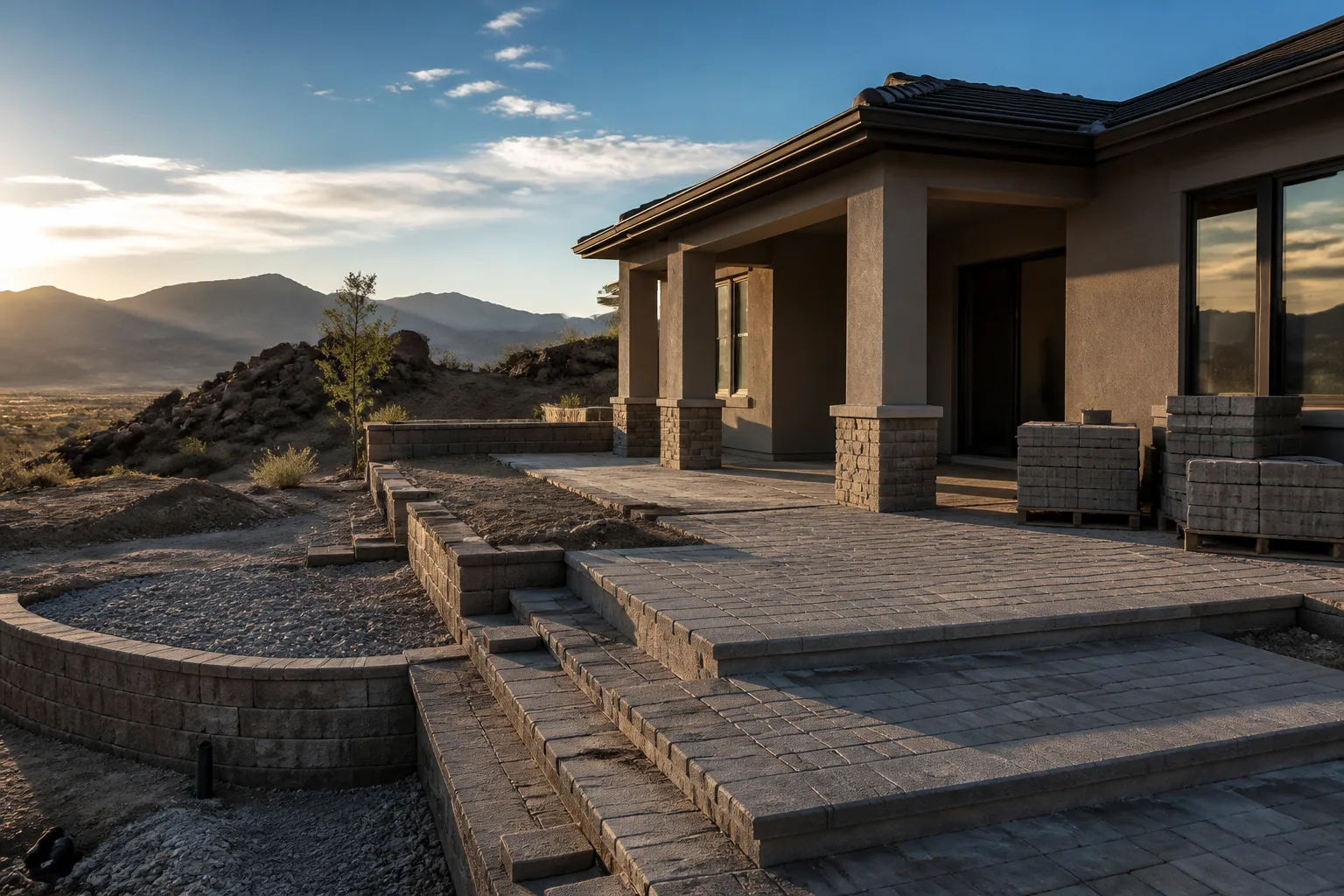
Belgard General Contractor in Mesquite: A Homeowner’s Guide
Two Belgard patios can look identical on the day they’re finished and behave nothing alike two summers later. The difference is almost never the pavers. It’s what’s underneath: whether the base was dug to the right depth, built from the right aggregate, and compacted to a standard someone can actually verify. Belgard’s limited lifetime warranty on its hardscape products depends on installation meeting those standards. In Mesquite’s soil, skipping them shows up fast. If you’d rather not gamble on it, call (844) 761-8665 and we’ll walk your site with you.
Here’s the hook, and it’s the whole point of this guide: pavers sit on a base that nobody sees again. Four inches of properly compacted Class II base rock and two inches of whatever was cheap that week look the same under a finished patio. Until year two, when the ones with the bad base start to rock.
Why does base preparation decide whether your Belgard warranty holds in Mesquite?
Belgard’s warranty covers manufacturing defects in the paver itself. It does not cover a paver that cracks because the base beneath it settled, and it does not cover a patio that heaves because water got trapped in the subgrade. Those are installation failures, and the manufacturer will tell you so. That’s why the base is the part of the job that actually protects your money.
The Interlocking Concrete Pavement Institute (ICPI) sets the base standard most manufacturers, including Belgard, point to for warranty compliance. For a residential patio or walkway, that generally means:
- Excavation depth: enough to fit the base, the bedding layer and the paver while keeping the finished surface below the surrounding grade so water drains away from the house.
- Base material: a graded, compactable aggregate – Class II base rock is the common standard – not fill dirt, not sand, not rubble.
- Compaction: placed in lifts and compacted with a plate compactor to a density that can be measured, not eyeballed.
- Bedding layer: a thin, screeded layer of coarse sand, typically around an inch, that lets the pavers seat evenly.
In our experience, the contractors who skip steps skip them here, because nobody’s watching and it saves a day of labor. If a Belgard paver fails because the base was three inches of loose material, the manufacturer has a legitimate out. The homeowner is the one holding the bag.
How does Mesquite’s soil undermine a paver base?
Mesquite sits on expansive clay soils, and those soils move with moisture. During monsoon season, when a hard rain soaks the ground, clay swells. In the dry stretch that follows, it shrinks and cracks. A paver base built over that subgrade without proper excavation and compaction gives the clay room to move, and the patio above it moves with it.
What that looks like on a finished Belgard job:
- Pavers that rock underfoot in one corner while the rest of the patio is solid.
- Joint sand that washes out and leaves visible gaps after the first heavy storm.
- Lipper – one paver sitting proud of its neighbor – where the base settled unevenly.
- Water pooling against the house because the finished grade dropped after installation.
We’ve seen all four on patios less than three years old in Mesquite. None of them were the paver’s fault. The fix is to excavate deep enough to reach stable subgrade, build the base back up in compacted lifts, and keep the finished surface pitched away from the foundation. That’s slower and it costs more up front. It’s also the only version of the job that holds.
Which joint sand belongs in a Mesquite patio – polymeric or regular?
For Mesquite, polymeric joint sand is the right call in almost every situation. Regular sand is cheaper and easier to sweep in, and it fails here for two reasons: wind and heat. Loose sand blows out of the joints over a season, and the heat accelerates the breakdown of anything that isn’t stabilized. Once the joints open up, ants move in, and the sand that’s left washes out with the first monsoon rain.
Polymeric sand is mixed with a binder that sets up after you wet it, forming a semi-solid joint that resists washout and blocks insects. Belgard specifies polymeric sand meeting ASTM C144 for many of its installations, and the joint sand choice is one of the details that can matter for warranty claims. Some homeowners ask for regular sand to save money. In our experience that’s a false economy in this climate.
The one caveat: polymeric sand has to be installed correctly. It needs the right moisture level to cure, and it needs to be swept in clean, without smearing on the paver face. Badly installed polymeric sand looks worse than regular sand and fails almost as fast. Ask your contractor which product they’re using and read the label with them.
What edge restraint does Belgard require, and why does spiked plastic fail here?
Edge restraint holds the whole patio together. Without it, the outer pavers spread under load and the pattern migrates. Belgard specifies edge restraints that meet ICPI guidelines, and the common options are spiked plastic edging, aluminum edge restraint, and concrete curb. Each one behaves differently in Mesquite’s caliche soil.
Caliche is the hard, cement-like layer that forms in desert soils. It’s often just beneath the surface, and it’s miserable to drive a spike through. A contractor who tries to set spiked plastic edging in caliche will either bend spikes, skip spikes, or drive them at an angle that gives way later. When the spikes don’t hold, the edge restraint lifts and the patio starts to spread at the perimeter, usually starting in the corner nearest the driveway.
The stronger approach in our experience is a concrete curb poured against the paver edge, or a spiked restraint installed with the correct fastener depth through the caliche layer into stable material. That’s a decision you want made on site after the base is exposed, not from a catalog. Ask what edge restraint is specified before you sign anything.
What should your contractor document at the base stage?
This is the part almost no homeowner asks about, and it’s the part that determines whether a warranty claim is worth making. The warranty claim lives or dies on evidence of how the base was built. If a paver fails and the manufacturer asks how deep the base was and how it was compacted, “we did it right” is not an answer.
At Bradford, we document the base stage before a single Belgard paver goes down. That means photos of the excavated subgrade, photos of the base material in place at each lift, and documentation of the compaction readings taken with a plate compactor. Those records go to the homeowner along with the written price and the signed paperwork. If something goes wrong two years later, the file exists and it tells the story.
You should ask for the same from any contractor you hire. If someone tells you compaction readings aren’t necessary on a residential patio, that’s a clue about how they approach the rest of the job. General contracting on a Belgard install is the same discipline as a kitchen rough-in: the parts nobody sees are the parts that matter. If you’re planning a larger remodel that includes hardscape, our General Contractor in Mesquite page covers how we sequence outdoor and interior work.
When should you call a pro instead of handling it yourself?
Small repairs are reasonable DIY territory. Re-sanding joints, replacing a cracked paver, or adjusting one that’s lipping slightly can be a weekend job. The line is the base. If pavers are rocking in a wide section, if the patio has settled near the foundation, or if you’re planning a full Belgard install, get a professional. A base built on faith is not a base – and once it fails, undoing it means pulling up every paver to get back to the material underneath.
The same logic applies to structural work. If your hardscape project connects to a covered patio roof, an outdoor kitchen or a structural wall, it crossed from landscaping into general contracting, and it needs the permits and inspection that go with that. Our team has technicians with up to 22 years of experience in this kind of work, and we pull permits and pass inspections rather than treating them as an inconvenience.
Related services in Mesquite: if your project reaches inside the house, our Kitchen Remodeling in Mesquite, Bathroom Remodeling in Mesquite, and Bradford Remodeling Mesquite home pages cover what we do there.
What does a Belgard hardscape project cost in Mesquite?
Pricing depends on square footage, site conditions and material selection, but here’s the range you should expect before you start talking to contractors in Mesquite. These are line-item estimates, not a quote.
| Item | Typical range |
|---|---|
| Belgard paver material | $5 – $12 per square foot |
| Base prep, Class II rock, excavation | $4 – $8 per square foot |
| Polymeric joint sand | $1 – $2 per square foot |
| Edge restraint (aluminum or curb) | $3 – $8 per linear foot |
| Labor – installation | $8 – $15 per square foot |
| Concrete curb (where specified) | $12 – $20 per linear foot |
A 300-square-foot patio typically lands between $6,000 and $12,000 depending on material and site conditions. A driveway will be higher because the base depth and compaction standard are more demanding. If you get a price well below that range, look hard at the base line item. That’s where the savings came from.
Bradford gives a written price before any work starts, with no change orders hidden in the fine print. Call (844) 761-8665 to schedule a free estimate.
The Bottom Line
Belgard makes a good paver. The base under it is what determines whether you get a patio that looks the same in year five as it did on day one, or one that rocks in the corner after two monsoon seasons. Require ICPI-compliant base depth from a graded aggregate, compaction in lifts that can be measured, polymeric joint sand, and an edge restraint that’s correct for caliche soil. Then require documentation of all of it in writing, with photos and compaction readings you keep.
The 365-Day Done Right Promise is our written guarantee that if anything we install fails within a year, we come back and correct it at no charge. It’s not a substitute for doing the base right the first time, but it’s the kind of paperwork that makes a homeowner’s life simpler. If you’re in Mesquite and need help, Bradford Remodeling Mesquite offers free estimates – call (844) 761-8665.
Frequently Asked Questions
No. Belgard’s limited lifetime warranty covers manufacturing defects in the paver itself, not installation failures like base settlement or joint washout. If a paver cracks because the base was under-compacted, that’s an installation issue and the manufacturer can decline the claim. The fix is to require documented base prep before installation begins.
For a residential patio or walkway, ICPI guidelines call for a base built from a graded aggregate like Class II base rock, placed and compacted in lifts, with a thin bedding sand layer on top. Exact depth depends on the application and soil conditions. For a driveway, the base must be deeper and more heavily compacted because it carries vehicle loads. Your contractor should specify the depth in the written scope before work begins. Call (844) 761-8665 to discuss a specific site.
Rocking pavers usually mean the base has settled unevenly. In Mesquite, the culprit is often expansive clay soil that swells during monsoon season and shrinks in the dry stretch that follows. If the base was shallow or under-compacted, the clay movement telegraphs through to the pavers. A patio less than three years old that rocks in one area is a sign the base needs investigation.
For most applications in Mesquite, polymeric sand is the better choice. Regular sand blows out over a season and washes out during monsoon rains, which opens the joints to ant infiltration and joint washout. Polymeric sand sets up with a binder that resists both. The qualification: polymeric sand has to be installed with the correct moisture level to cure, so the contractor’s technique matters more than the product name on the bag.
Ask for photos of the excavated subgrade, photos of the base material in place at each lift, and documentation of compaction readings taken with a plate compactor. Those records are the paper trail behind any warranty claim. Ask for them before you sign, not after the patio is finished, because the base is covered once the pavers go down and you can’t verify it later.
Written by the team at Bradford Remodeling Mesquite.
Need Construction Help?
Call Bradford Remodeling Mesquite - licensed & insured, here with fast after-hours help in Mesquite.
(844) 761-8665